Posts

Showing posts with the label Retro PC

Tandy 1000 TL/2 - Having Your Cake & Eating It Too

Image
The Tandy 1000 was the first computer that I owned. I have very fond memories of it going all the way back to 1985. It is no wonder I own 5 of them in total. My Tandy 1000 TL/2 is what I am going to cover today and what makes it unique from all the other Tandy 1000s I have. In 1988 Radio Shack released the Tandy 1000 SL & TL computers. These had several enhancements over previous models. The graphics could now go all the up to 640x200x16 colors on a standard CGA monitor. It had a DAC for recording and playback of digital sound. MS-DOS 3.3 was included in ROM for almost instant booting of the computer without need for a floppy diskette. The keyboard connector was now a standard DIN5 keyboard connector and Tandy included an Enhanced 101 keyboard. System setup was done with a separate program that saved the system configuration to an EEPROM. The TL could be upgraded to 768K of memory. The extra 128K was then used for video memory freeing the lower 640K for DOS and user programs. The T...

The Little Known Epson Equity Ie - An IBM PS2 Model 30 Clone

Image
I have always had a fascination with 8086 XT class computers. Mainly because there were so few of them compared to the multitude of 8088 XT class computers out there. I own a Tandy 1000 SL with an 8MHz 8086 CPU (upgraded to an NEC V30). This is much faster than my Tandy 1000 SX with a 7.16MHz 8088 CPU (upgraded to a NEC V20). I have always wanted a 10MHz 8086 based system. These are as fast as you can officially go with an 8086. Intel only made them to run up to 10MHz. I had been keeping my eyes open for quite some time when an Epson Equity Ie came up for sale on eBay. The computer was in excellent condition and I ended up buying it. This is the only computer I know of outside of IBM’s PS2 Model 25 & 30 that have MCGA graphics onboard. This is basically a cut down version of IBM’s VGA chip. It only has 64K of ram vs 256K for the VGA. It supports the 320x200 256 color mode of the VGA as well as 640x480 2 color mode, but none of the VGA’s 16 color modes. This makes it pretty useless ...

Turning A $20 Craigslist Purchase Into A 500MHz Gaming Powerhouse

Image
Last year I picked up a couple of computers as part of a Craigslist purchase from a local seller. One the computers cost $20 and was described by the seller as "nothing special". It had a PC Chips M572 motherboard with an i430TX chipset, Pentium 133MHz CPU, 40MB of ram, 40GB hard drive, 1.44MB 3.5 floppy drive, DVD drive, 8MB ATI RageXL PCI video card and a low end Ensoniq PCI sound card. I was originally going  to take the motherboard out, but there was something about that motherboard that I remembered it could be upgraded with a much better CPU. I checked online and there was indeed a patched BIOS available to allow for the use of a K6-2+ or K6-III+ CPU. I download the patched BIOS and applied the BIOS update to the motherboard. The M572 motherboard has PnP CPU setup in the BIOS. There are no jumpers to set. This makes for easy changes to the motherboard. You can set the voltage from 2.0 to 3.5 volts, FSB speed of 60, 66, 75, or 83 MHz and CPU multiplier of 1.5 to 5.5. I...

386/40 - Fun, Frustration, & Taking It To The Next Level

Image
  One of the computers I wanted to add to my retro computing collection was a 386. My initial plan was to find a period correct case and then just build it out from there. I made a post on the Vintage Computer Forum asking for such a case. A forum member, who is a recycler, reached out to me he may have what I was looking for. It turns out he had complete systems. I picked the one I liked which he told me that one was a 386. To my surprise when I got it was a 386/40 in nearly perfect condition. I upgraded the memory to 8MB, added a Cyrix FasMath math coprocessor,  XT-IDE CompactFlash adapter, Tseng Labs ET4000AX video card, Sound Blaster 16 sound card and 3Com 3C509B network card. I replaced the AMD 386/40 CPU with Cyrix 486DLC/40 CPU. I thought I was all set, but then problems began to set in. I could not get any protected mode games like Doom to run. They would just start up and then quit. I could not load an extended memory manager like EMM386 or QEMM386. I would get prot...

NuXT motherboard - A May-December Marriage Of Technology

Image
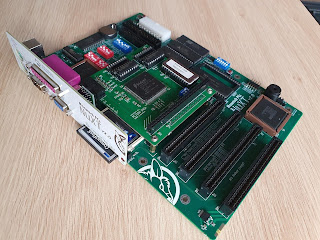
One of the biggest hurdles to overcome in the Retro Computing world is obtaining period correct parts. The older the computer is, the harder and more expensive it becomes to put together a complete system. Everything from expansion cards to the keyboard and monitor are all from a bygone  era. This is especially true for PC/XT class computers. The NuXT motherboard tries to address all of this while staying true to this type of computer from the 1980s. The NuXT is sold by Monotech Vintage PCs out of New Zealand. Here is a list of features and a few pictures: 8088 and NEC V20 CPU support 8087 math co-processor support 9.55MHz, switchable to 4.77MHz or 7.16MHz on the fly Dual 64K ROM, switchable with DIP switch, writeable 832K RAM 640K conventional up to 192K UMB RAM (160K max when using VGA) UMB-Configured DOS 6.22 uses only 10K conventional! PC/104 Expansion Platform (optional) PC/104 SVGA card, with VGA...

IBM enters the fray, clone wars, when 640K is not enough

The personal computer market really started as something for hobbyists in the mid-1970s with the introduction of computers like the MITS Altair 8800. These early computers were in kit form and had to be assembled, putting them out of reach of mere mortals. That all changed in 1977 with the introduction of the Apple II, Commodore Pet, and TRS-80 Model I. All three of these computers were pre assembled and ready to use. This opened the door to a much wider audience and the popularity only grew from there. 1980 rolled around and there was a major player absent from this market, IBM. They had been keeping an eye on the personal computer industry and now wanted a piece of it. The biggest problem was that development cycles for any new IBM computer was on the order of 5 years. They designed almost everything in house from the ground up. They did not have that kind of time, so they did something totally out of character. They gave a group total control without having to get management approva...

Why I do this

I have been in the IT industry for almost 38 years. I went to tech school from 1983-1985. I got my first IT job shortly after graduating and within a few weeks I bought my first computer, a Tandy 1000 at my local Radio Shack. It started me down a road of always having computers around to fill my time as a hobby. I had a few older computers from 1999 to 2011.   I had two Tandy 1000s and two older 68K Macintoshes. Over the years I just lost interest in those computers. I moved back to my hometown in 2011 and wanted to downsize all the stuff I collected. Those 4 computers ended up being recycled. A decision I now regret doing. I got an iMac G5 in 2014 to run older Macintosh software and that satisfied my Retro Macintosh computing needs. I used emulators like DOSBox to run any Retro PC software I needed. I never felt a need to have actual Retro PC hardware to run on. DOSBox did a good enough job. The reason I moved back to my hometown was to be closer to my family, especially my parent...